Recently, Professor Hu Jia’s team from the Department of Cardiovascular Surgery at our hospital, supported by West China Hospital’s Clinical New Technology Projects (Medical Clinical New-2018-091 and 20HXJS015), successfully performed staged procedures on a 78 year‑old high‑risk patient with concomitant coronary artery disease and a giant thoracoabdominal aortic aneurysm. The patient underwent “coronary artery bypass grafting surgery followed by 3D print‑assisted, precise in vitro fenestration and multi‑visceral branch stent implantation for total endovascular repair of the thoracoabdominal aortic aneurysm.” The patient was discharged uneventfully.
Coronary artery bypass grafting is one of the most delicate operations in cardiac surgery, and total endovascular repair of thoracoabdominal aortic aneurysms demands extremely high surgical skills from the cardiovascular surgeon. The success of the procedure directly depends on the reconstruction of branch arteries. Moreover, before total endovascular repair, comprehensive and precise evaluation of the aortic condition and the three‑dimensional anatomy of the branch arteries is mandatory; any intraoperative misalignment would be devastating. Few cases of staged coronary artery bypass grafting and total endovascular repair for thoracoabdominal aortic aneurysms have been reported in China or internationally. The successful implementation of this procedure demonstrates that the Department of Cardiovascular Surgery at West China Hospital possesses first‑class capabilities in combining open surgery and interventional techniques to treat complex cardiovascular pathologies, placing its aortic minimally invasive technology at an advanced level both domestically and internationally.
The patient, Mr. Liu, aged 78, was admitted with “difficulty in defecation and abdominal discomfort for over two years, worsening for three days.” Preoperative contrast‑enhanced CT revealed multiple penetrating aortic ulcers of the descending thoracic aorta and a giant thoracoabdominal aortic aneurysm, with a maximum diameter of 75 mm (Figure 1). Perioperative screening coronary angiography showed concomitant coronary artery disease (Figure 2). The patient’s aneurysm was large, and he had a long history of poorly controlled hypertension, placing him at high risk of spontaneous rupture. Conventional endovascular repair of the abdominal aorta could not completely exclude the aneurysm. At the same time, the patient had multivessel coronary artery disease, with a high risk of perioperative and long‑term myocardial infarction, and the coronary lesions could not be effectively treated with medication or coronary stents. However, at 78 years of age, either simultaneous or staged open surgery for both the coronary lesions and the thoracoabdominal aortic aneurysm carried extremely high surgical trauma and risk. The complex condition, the high difficulty of the surgery, and the unpredictable risks and complications left the patient and his family in a dilemma, hesitant to make a decision.
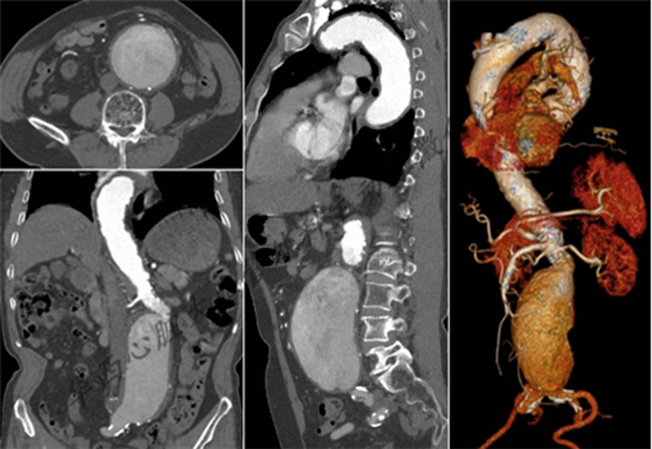
Figure 1. Preoperative CT
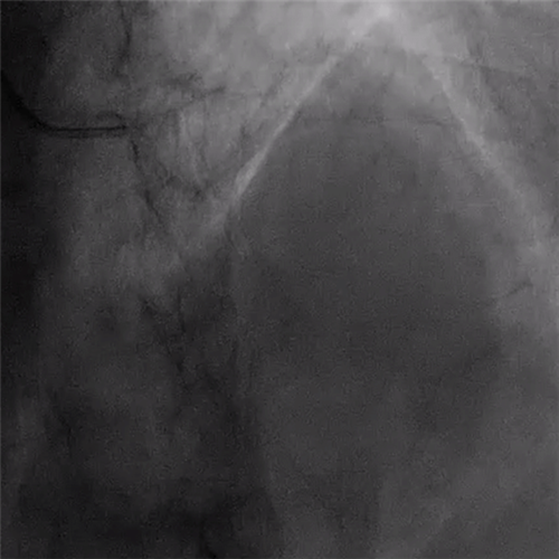
Figure 2. Preoperative coronary angiography
For this 78‑year‑old patient, the aortic lesion was a type IV thoracoabdominal aortic aneurysm with multiple penetrating ulcers of the descending thoracic aorta, involving the abdominal aortic branch zone. Open surgical replacement of the thoracoabdominal aorta after coronary artery bypass grafting would carry extremely high trauma and risk. After thorough evaluation of the patient’s condition and aortic anatomy, and following a full departmental discussion of the surgical plan, the team decided on a staged approach. The patient would first undergo coronary artery bypass grafting; after a period of recovery, he would then undergo total endovascular repair of the thoracoabdominal aortic aneurysm. This strategy aimed to completely resolve both the coronary and thoracoabdominal aortic pathologies while minimizing perioperative risk.
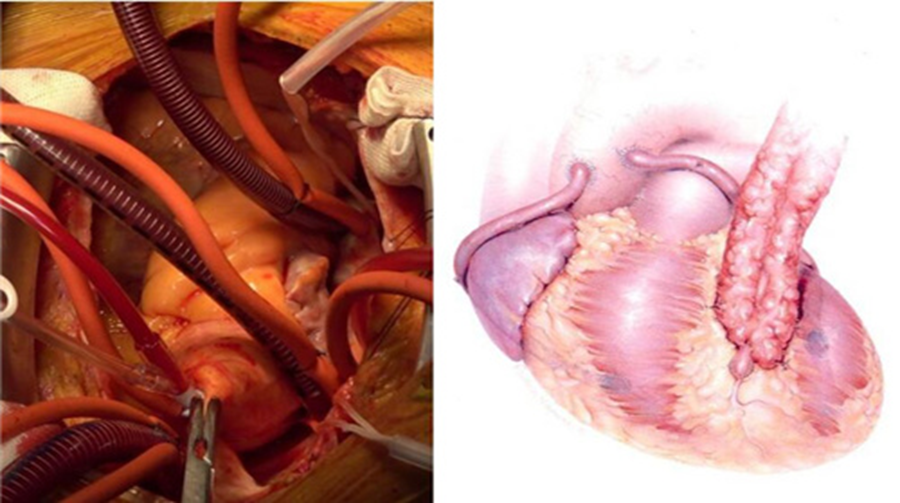
Professor Hu Jia of the Aortic Minimally Invasive Treatment Team, Department of Cardiovascular Surgery, West China Hospital, patiently explained the complexity of the disease, the proposed surgical plan, and the associated risks to the patient and his family. The patient and his family, seeing a ray of hope, decisively chose surgical treatment. First, with the collaboration of the anesthesia team (Professor Zeng Jun) and the cardiopulmonary bypass team (Professor Du Lei), the patient underwent coronary artery bypass grafting (left internal mammary artery to left anterior descending artery; ascending aorta to great saphenous vein to circumflex artery; ascending aorta to great saphenous vein to right coronary artery) (Figures 6, 7). The patient was discharged uneventfully on postoperative day 6.
|
Figure 6. coronary artery bypass grafting |
Figure 7. Coronary artery bypass grafting |
One month later, the patient was readmitted for surgery on the thoracoabdominal aortic aneurysm. After precise measurements on preoperative contrast‑enhanced CT and repeated evaluation of the patient’s aortic anatomy, the team decided to perform a total endovascular repair using in vitro precise fenestration and multi‑visceral branch stent implantation. At the same time, based on the preoperative contrast‑enhanced CT, a 3D‑printed life‑sized aortic aneurysm model was created to enable more precise intraoperative reconstruction of the branch arteries and complete exclusion of the abdominal aortic aneurysm. The surgery was successfully performed in collaboration with the anesthesia team (Professor Li Qian) and the Aortic Minimally Invasive Treatment Team of the Department of Cardiovascular Surgery.
Postoperative angiography showed accurate placement of the main stent, good exclusion of the aneurysm sac without endoleak, unobstructed blood flow in the abdominal branch arteries, appropriate distal diameter restriction, and a natural stent transition, with an overall satisfactory result.
Surgical procedure: Based on the 3D-printed model and preoperative CTA, the positions for fenestrations were determined. In vitro fenestrations were created on the stent at the ostia of the celiac artery, superior mesenteric artery, and both renal arteries, and spring coils were sutured as markers. The stent was then downsized and reloaded into the delivery sheath. Intraoperatively, angiography was performed via the femoral artery approach. After controlled hypotension, the pre‑fenestrated main stent was introduced. The markers were aligned with each branch ostium, and the main stent was deployed in segments. A guidewire and catheter were introduced via the left brachial artery to sequentially access the pre‑fenestrated windows of both renal arteries, the celiac artery, and the superior mesenteric artery, and branch stents were implanted to revascularize these vessels. Finally, the infrarenal abdominal aortic stent and bilateral iliac artery stents were deployed, and the right internal iliac artery was reconstructed. Postoperative angiography showed accurate positioning of the main stent, good exclusion of the aneurysm sac without endoleak, and unobstructed flow in the branch arteries (Figure 8).
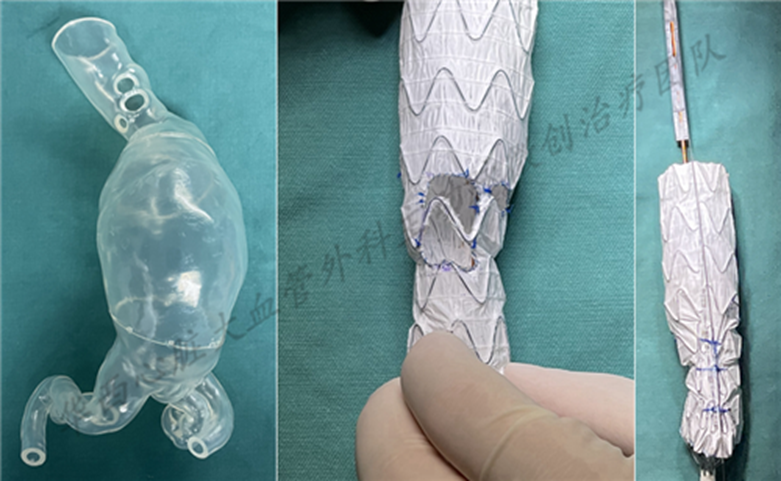
Figure 8. 3D printing, in vitro fenestration, and downsizing completed.
After the second procedure, the patient was transferred to the Cardiothoracic Intensive Care Unit. With the joint efforts and meticulous care of the medical team led by Associate Chief Physician Cao Ge and Head Nurse Zeng Ling, the patient was transferred back to the general ward on the first postoperative day. Postoperative CTA of the dissecting aneurysm showed good overall morphology of the thoracoabdominal aorta, patent blood flow in the abdominal branch arteries, complete exclusion of the aneurysm, and no obvious endoleak (Figure 9). The patient recovered uneventfully without any surgical complications and was discharged on the third postoperative day.
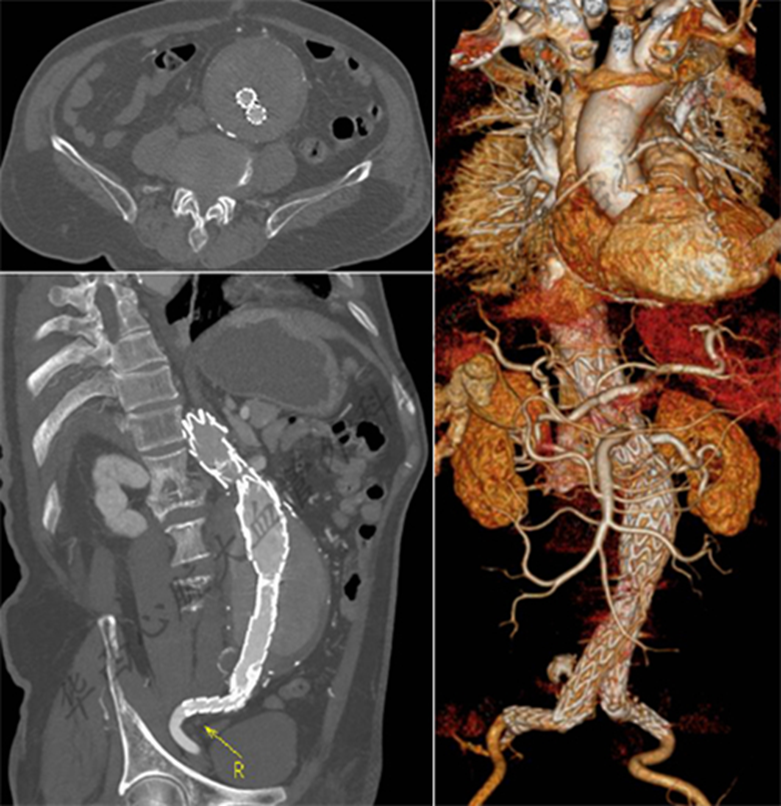
Figure 9 Postoperative CT
Thoracoabdominal aortic aneurysm is one of the most difficult aortic diseases to treat in cardiovascular surgery. When combined with other cardiovascular pathologies, it becomes even more challenging. Traditional open thoracoabdominal aortic replacement under cardiopulmonary bypass requires a thoracoabdominal incision, resulting in substantial surgical trauma and high rates of mortality, paraplegia, and major organ complications. The emergence of branched hybrid surgery avoids thoracotomy and high clamping of the thoracic aorta, but still requires laparotomy and carries risks such as bypass graft occlusion, endoleak, and vital organ failure. With the development of endovascular techniques and the advent of new devices, total endovascular treatment of thoracoabdominal aortic aneurysms has become possible, offering a new surgical option for elderly high-risk patients. Total endovascular repair can isolate the diseased segment in a minimally invasive manner as much as possible, but individualized and precise endovascular repair strategies should be developed based on the patient's aortic anatomy and lesion characteristics.
The successful implementation of this staged procedure – coronary artery bypass grafting followed by 3D‑printing‑assisted, precise in vitro fenestration and multi‑visceral branch stent implantation for total endovascular repair of a thoracoabdominal aortic aneurysm – demonstrates the capability of West China Hospital as a center for complex and difficult diseases in Southwest China. We possess both the ability to perform traditional open surgery and complex total endovascular repair, using minimally invasive and precise surgical strategies to completely eradicate the pathology while minimizing perioperative risk. Furthermore, the multidisciplinary collaboration involving the Department of Cardiovascular Surgery, Anesthesiology, Intensive Care, and other departments provides an additional strong safeguard for patients with such complex and severe diseases.
References
[1] Calero A, Illig KA. Overview of aortic aneurysm management in the endovascular era. Semin Vasc Surg, 2016, 29: 3-17.
[2] Crawford ES, DeNatale RW. Thoracoabdominal aortic aneurysm: observations regarding the natural course of the disease. Journal of Vascular Surgery, 1986, 3(4):578-582.
[3] Dayama A, Sugano D, Reeves JG, et al. Early outcomes and perioperative risk assessment in elective open thoracoabdominal aortic aneurysm repair: An analysis of national data over a five year period. Vascular, 2016, 24(1):3–8. doi: 10.1177/170853