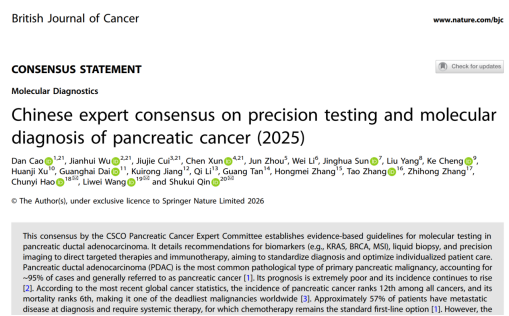
The “Chinese expert consensus on precision testing and molecular diagnosis of pancreatic cancer (2025)” has been published online in the British Journal of Cancer, a leading UK journal in the field of oncology. The consensus was led by the team of Professor Cao Dan from the Abdominal Oncology Ward at West China Hospital, Sichuan University (WCH). This marks the first time a Chinese expert consensus in the field of pancreatic cancer molecular diagnosis has been published on an internationally recognized academic platform.
The Chinese version of the consensus was first published domestically in 2025. The English version has been comprehensively updated and optimized to incorporate the latest global clinical evidence. Professor Cao Dan is the first author of the consensus. Associate Professor Cheng Ke and Associate Professor Xu Huanji served as consensus secretaries, contributing to the writing, revision, and publication process.
Under the overall guidance of the Pancreatic Cancer Expert Committee of the Chinese Society of Clinical Oncology (CSCO), the team collaborated with dozens of leading pancreatic cancer experts across China to systematically review and update the consensus. Key updates include the latest evidence on HRR pathway genetic testing, KRAS mutation-targeted therapy, and immunotherapy-related biomarker evaluation. The consensus also refines the clinical applicability of different testing technologies and criteria for result interpretation, further strengthening its practical utility in primary care settings. Notably, clinical research findings from Professor Cao Dan’s team on first-line immunotherapy combined with chemotherapy for advanced pancreatic cancer were incorporated as core evidence, with biomarker analysis results providing important support for the section on immunotherapy biomarker testing.
Pancreatic ductal adenocarcinoma is one of the most aggressive gastrointestinal malignancies, with a five-year survival rate in China still below 10%. The molecular heterogeneity of the disease has long been a major barrier to improving clinical outcomes. The international publication of this consensus shares Chinese practical experience in precision diagnosis and treatment of pancreatic cancer with the global community, providing clinicians in different countries and regions with practical guidance that is both actionable and contextually relevant.